


자료실
[유용한TIP] What Is the Pygmalion Effect? | Definition & Examples
- 2023-09-18 16:42:47
- hit4827
)
The Pygmalion effect refers to situations where high expectations lead to improved performance and low expectations lead to worsened performance. Although the Pygmalion effect was originally observed in the classroom, it also has been applied to in the fields of management, business, and sports psychology.
Example: Pygmalion effect
You want to research the influence of two storytelling methods on the vocabulary size improvement of children. To test this, the children are either given 20 minutes of storytelling from their teacher or 20 minutes of computerized storytelling.
You strongly believe the human aspect is needed to aid in the vocabulary development of children. You encourage the children in that group to pay attention and be excited, whereas you don’t show this behavior to the computer group.
The children in the first group are now paying more attention and feeling better about themselves than children in the other group, potentially leading to a Pygmalion effect.
The Pygmalion effect is also known as the Rosenthal effect, after the researcher who first observed the phenomenon.
What is the Pygmalion effect?
The Pygmalion effect is a psychological term used to describe the impact of positive or negative expectations on the performance of an individual or a group. It introduces bias into your research.
The underlying idea is that when a leader, authority figure, or role model believes we can succeed in a certain area, we will work hard to meet their expectations. This also implies that we do better when more is expected of us.
The Pygmalion effect has both academic and practical implications. For example, if a manager believes in the abilities of their team, the team will outperform one whose manager believes the opposite, even if the two teams are equally skilled.
Similarly, if a researcher has high expectations that patients assigned to the treatment group will succeed, these patients may have better outcomes than the control group. In this example, the Pygmalion effect takes the form of (unconscious) researcher bias.
How the Pygmalion effect works
The Pygmalion effect demonstrates the power expectations have in shaping behavior.
This effect occurs because we tend to internalize the labels others place upon us. We try to conform to those labels, whether positive or negative.
The Pygmalion effect works in a circular fashion:
- Others’ expectations about us influence their behavior towards us.
- Their behavior towards us influences how we see ourselves.
- How we see ourselves impacts our own behavior.
- Our behavior towards others influences their beliefs, reinforcing their expectations.
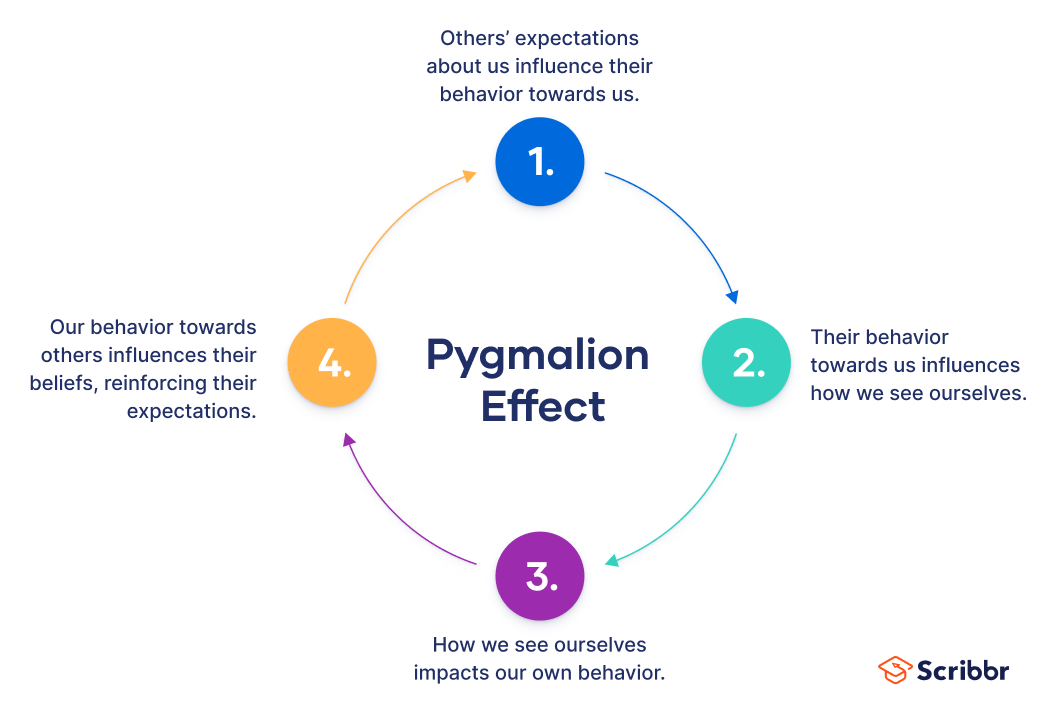
In other words, someone else’s high expectations for our performance doesn’t only impact how we act, but also how they act.
To apply this, let’s take the example of a teacher. A teacher’s expectations of students are conveyed in four ways:
- Climate
- Feedback
- Input
- Output
Climate refers to the atmosphere created by the person who holds the expectation, in this case, a teacher. This is often communicated nonverbally, perhaps by smiling and nodding or making eye contact. These cues can create a friendly and positive climate.
Feedback refers to the type of response the teacher gives to students. High-expectation students will likely receive more praise and more detailed feedback.
Input refers to the effort or energy the teacher invests. Some teachers tend to invest more time and effort in high-expectation students (e.g., by providing them with more difficult material).
Output refers to the tendency for teachers to call on “good” students more often, or encourage them to be more responsive.
Example: Pygmalion effect
Suppose a teacher believes her class can get high grades on the end-of-semester test. The teacher conveys this expectation by telling the students that she is sure they will do well if they work hard to prepare.
In the following weeks, while practicing mock exams in class, the teacher maintains a positive attitude: she encourages every student to answer and participate. Whenever students are mistaken, she takes the time to explain the correct answer.
Because the teacher values the students’ abilities and tries to create a climate of success, students are more likely to internalize this belief and work hard to prepare for the test. As the students attune their behavior to the teacher’s expectations, the teacher’s belief in her students is confirmed. This motivates her further to help her students do well.
Examples of the Pygmalion effect
The Pygmalion effect can explain how people perform in a variety of contexts.
Example: Pygmalion effect in business
You are conducting longitudinal research on the effectiveness of several branch bank managers over the course of one year.
Every few months, every manager gets a performance review. Those who fail to meet their revenue goals automatically get a negative review. In order to avoid further negative feedback, you observe that these managers are more likely to push safe but not-so-profitable loans.
This results in branches losing business to competitors and further negative reviews for these managers. To reverse the situation, the branch managers then start accepting as many loans as possible, even risky ones. This also results in decreased profits for the branches, as lessees are more likely to default.
After conducting semi-structured interviews with the branch managers, you realize their erratic behavior was an effort to avoid further damage to their career and self-esteem, rather than poor judgment. You observe that the managers who receive negative feedback in particular become less effective over time.
You conclude that the Pygmalion effect played a role in how the managers behaved.
The branch managers took the negative performance appraisal as a sign of failure and mistrust in their abilities to perform. They internalized this belief, and this affected their actions. Their poor decisions led to even worse performance, confirming the expectations of their higher-ups.
In the context of education, the Pygmalion effect illustrates that teachers run the risk of only getting from students what they expect from them.
Example: Pygmalion effect in education
Suppose you are a middle school teacher. On the first day of school, you notice that you have a student whose two older siblings you had in previous years. Both of them were often troublemakers.
Unconsciously, you’ve already labeled the student a troublemaker. This, in turn, influences how you treat her. Whenever she misbehaves even a little bit, you feel annoyed and disrespected.
Even though she is not the only student occasionally misbehaving, you reprimand her much more strongly and regularly than other students. In turn, the student feels you are being unfair to her and eventually loses interest in your lessons, so that your expectations act as a “self-fulfilling prophecy.”
Different expectations usually lead to different treatments, even when this occurs unintentionally.
Why is the Pygmalion effect important?
The Pygmalion effect has implications in various contexts:
- Although this mechanism is mostly unconscious, it can also be used to intentionally enable other people’s development, like students, employees, or athletes. Coaches, for example, who let athletes know that they expect more of them can lead them to greater achievement as athletes.
- Being aware of the Pygmalion effect can help people in leadership positions realize how their attitude and expectations of their subordinates can affect them. A leader’s bias can influence their expectations of others and impose unfair or stereotypical labels on them.
- The Pygmalion effect can also affect entire groups and organizations. For example, it can shape the climate in entire departments, creating a culture of low expectations, or the opposite.


주소 : 서울시 강남구 청담동 41번지 청담빌딩 5층 | 대표번호 : 02-554-0805 | 고객센터 : 1899-0805
E-mail: info15@brainphd.co.kr | 개인정보관리책임자 : 김동효
저작권 (c) brainphd.co.kr 가 판권을 소유함.