


자료실
[유용한TIP] How to Find the Median | Definition, Examples & Calculator
- 2025-03-21 16:27:00
- hit6356
)
The median is the value that’s exactly in the middle of a dataset when it is ordered. It’s a measure of central tendency that separates the lowest 50% from the highest 50% of values.
The steps for finding the median differ depending on whether you have an odd or an even number of data points. If there are two numbers in the middle of a dataset, their mean is the median.
The median is usually used with quantitative data (where the values are numerical), but you can sometimes also find the median for an ordinal dataset (where the values are ranked categories).
Find the median with an odd-numbered dataset
We’ll walk through steps using a small sample dataset with the weekly pay of 5 people.
Dataset
| Weekly pay (USD) | 350 | 800 | 220 | 500 | 130 |
|---|
Step 1: Order the values from low to high.
Ordered dataset
| Weekly pay (USD) | 130 | 220 | 350 | 500 | 800 |
|---|
Step 2: Calculate the middle position.
Use the formula  , where n is the number of values in your dataset.
Calculating the middle position
| Formula | Calculation |
|---|---|
|
  |
The median is the value at the 3rd position.
Step 3: Find the value in the middle position.
Finding the median
| Weekly pay (USD) | 130 | 220 | 350 | 500 | 800 |
|---|
The median weekly pay is 350 US dollars.
Find the median with an even-numbered dataset
In an even-numbered dataset, there isn’t a single value in the middle of the dataset, so we have to follow a slightly different procedure.
Let’s add another value to the dataset. Now you have 6 values.
Dataset
| Weekly pay (USD) | 350 | 800 | 220 | 500 | 130 | 1150 |
|---|
Step 1: Order the values from low to high.
Ordered dataset
| Weekly pay (USD) | 130 | 220 | 350 | 500 | 800 | 1150 |
|---|
Step 2: Calculate the two middle positions.
The middle positions are found using the formulas  and
and  , where n is the number of values in your dataset.
Calculating the middle positions
| Formula | Calculation |
|---|---|
|
  |
|
 |
The middle values are at the 3rd and 4th positions.
Step 3: Find the two middle values.
Middle values
| Weekly pay (USD) | 130 | 220 | 350 | 500 | 800 | 1150 |
|---|
The middle values are 350 and 500.
Step 4: Find the mean of the two middle values.
To find the median, calculate the mean by adding together the middle values and dividing them by two.
Calculating the median
Median: 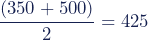
The median weekly pay for this dataset is is 425 US dollars.
Find the median with ordinal data
The median is usually used for quantitative data, which means the values in the dataset are numerical. But you can sometimes also identify the median for ordinal data.
Ordinal data is organized into categories with a rank order – for example language ability level (beginner, intermediate, or fluent) or level of agreement (strongly agree, agree, etc.).
The process for finding the median is almost the same.
Odd-numbered dataset
We’ll walk through the steps for an odd-numbered ordinal dataset with 7 values.
You categorize reaction times of participants into 3 groups: slow, medium or fast.
First, order all values in ascending order.
Ordered dataset
| Reaction speed | Slow | Slow | Medium | Medium | Fast | Fast | Fast |
|---|
Next, find the middle value using , where n is the number of values in the dataset.
Calculating the middle position
| Formula | Calculation |
|---|---|
|
  |
The median is the value at the 4th position.
Finding the median
| Reaction speed | Slow | Slow | Medium | Medium | Fast | Fast | Fast |
|---|
The median reaction speed is Medium.
Can you find the median for an even-numbered ordinal dataset?
The mean cannot be calculated for ordinal data, so the median can’t be found for an even-numbered dataset.
For example, if the two middle values are “slow” and “medium,” you can’t calculate the mean of these values.
In practice, ordinal data is sometimes converted into a numerical format and treated like quantitative data for the sake of convenience. Then the mean of the middle values can be calculated to find the median.
While this is considered acceptable in some contexts, it is not always seen as correct.
When should you use the median?
The median is the most informative measure of central tendency for skewed distributions or distributions with outliers.
In skewed distributions, more values fall on one side of the center than the other, and the mean, median and mode all differ from each other.
In a positively skewed distribution, there’s a cluster of lower scores and a spread out tail on the right.
In a negatively skewed distribution, there’s a cluster of higher scores and a spread out tail on the left.
Because the median only uses one or two values from the middle of a dataset, it’s unaffected by extreme outliers or non-symmetric distributions of scores. In contrast, the positions of the mean and mode can vary in skewed distributions.
For this reason, the median is often reported as a measure of central tendency for variables such as income, because these distributions are usually positively skewed.
The level of measurement of your variable also determines whether you can use the median. The median can only be used on data that can be ordered – that is, from ordinal, interval and ratio levels of measurement.
Frequently asked questions about the median
- What are measures of central tendency?
-
Measures of central tendency help you find the middle, or the average, of a data set.
The 3 most common measures of central tendency are the mean, median and mode.
- The mode is the most frequent value.
- The median is the middle number in an ordered data set.
- The mean is the sum of all values divided by the total number of values.
- How do I find the median?
-
To find the median, first order your data. Then calculate the middle position based on n, the number of values in your data set.
- If n is an odd number, the median lies at the position .
- If n is an even number, the median is the mean of the values at positions and .
- If n is an odd number, the median lies at the position
- When should I use the median?
-
The median is the most informative measure of central tendency for skewed distributions or distributions with outliers. For example, the median is often used as a measure of central tendency for income distributions, which are generally highly skewed.
Because the median only uses one or two values, it’s unaffected by extreme outliers or non-symmetric distributions of scores. In contrast, the mean and mode can vary in skewed distributions.
- Which measures of central tendency can I use?
-
The measures of central tendency you can use depends on the level of measurement of your data.
- For a nominal level, you can only use the mode to find the most frequent value.
- For an ordinal level or ranked data, you can also use the median to find the value in the middle of your data set.
- For interval or ratio levels, in addition to the mode and median, you can use the mean to find the average value.
Bhandari, P. (2023, June 21). How to Find the Median | Definition, Examples & Calculator. Scribbr. Retrieved July 30, 2024, from https://www.scribbr.com/statistics/median/


주소 : 서울시 강남구 청담동 41번지 청담빌딩 5층 | 대표번호 : 02-554-0805 | 고객센터 : 1899-0805
E-mail: info15@brainphd.co.kr | 개인정보관리책임자 : 김동효
저작권 (c) brainphd.co.kr 가 판권을 소유함.