


자료실
[유용한TIP] How to Find the Range of a Data Set | Calculator & Formula
- 2025-03-24 15:07:00
- hit4578
)
In statistics, the range is the spread of your data from the lowest to the highest value in the distribution. It is a commonly used measure of variability.
Along with measures of central tendency, measures of variability give you descriptive statistics for summarizing your data set.
The range is calculated by subtracting the lowest value from the highest value. While a large range means high variability, a small range means low variability in a distribution.
Calculate the range by hand
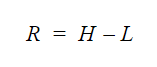
The formula to calculate the range is:
-
R = range
-
H = highest value
-
L = lowest value
The range is the easiest measure of variability to calculate. To find the range, follow these steps:
-
Order all values in your data set from low to high.
-
Subtract the lowest value from the highest value.
This process is the same regardless of whether your values are positive or negative, or whole numbers or fractions.
How useful is the range?
The range generally gives you a good indicator of variability when you have a distribution without extreme values. When paired with measures of central tendency, the range can tell you about the span of the distribution.
But the range can be misleading when you have outliers in your data set. One extreme value in the data will give you a completely different range.
Range example with an outlier
One value in your data set is replaced with an outlier.
Note
To get a clear idea of your data’s variability, the range is best used in combination with other measures of variability like interquartile range and standard deviation.
Frequently asked questions about the range
|
What is the range in statistics? In statistics, the range is the spread of your data from the lowest to the highest value in the distribution. It is the simplest measure of variability.
Can the range be a negative number? No. Because the range formula subtracts the lowest number from the highest number, the range is always zero or a positive number.
What are the 4 main measures of variability? Variability is most commonly measured with the following descriptive statistics:
What’s the difference between central tendency and variability? While central tendency tells you where most of your data points lie, variability summarizes how far apart your points from each other. Data sets can have the same central tendency but different levels of variability or vice versa. Together, they give you a complete picture of your data. |
Bhandari, P. (2023, June 21). How to Find the Range of a Data Set | Calculator & Formula. Scribbr. Retrieved August 12, 2024, from https://www.scribbr.com/statistics/range/
논문과 관련하여 도움이 필요한 경우 친절하게 상담하고 있으니 편한 마음으로, 전화, 홈페이지, 카톡, 톡톡 등을 통해 상담을 받아보세요~
대표번호 : 02-554-0805
고객센터 : 1899-0805
24시간카톡상담 : brainphd
이메일 : info5044@brainphd.co.kr
#Article #Research #Paper #논문컨설팅 #석사논문 #박사논문 #공학논문 #사회복지논문 #건축학논문 #서울대박사 #논문통계 #SPSS #SCI논문 #학위논문
#논문교정 #부산논문 #대전논문 #간호학논문 #경영학논문 #마케팅논문 #음악논문 #미술논문 #교육학논문 #심리학논문 #의학논문


주소 : 서울시 강남구 청담동 41번지 청담빌딩 5층 | 대표번호 : 02-554-0805 | 고객센터 : 1899-0805
E-mail: info15@brainphd.co.kr | 개인정보관리책임자 : 김동효
저작권 (c) brainphd.co.kr 가 판권을 소유함.